Friday, November 14, 2025

I just found out... you think I'm spam.

If you are receiving my blog without having subscribed to it, I think I know why.

Most likely your email account was included in someone's contacts, and that person's account was hacked. Nasty bots then proceeded to record YOUR email address, using it not only to send you phishing emails, but your address was also used to sign up for all kinds of things you never asked for. Like my blog.

I figured this out when, after many months of not paying attention to my blog stats, I saw that my posts were being flagged as spam. I went into the mailing list, and saw obviously fake email addresses, but also apparently real ones. The giveaway was how many of these "subscribers" signed up on the same day, even when I had not posted anything recently. 

The hackers/bots behind this will not stop signing people up (I don't know why), but if all I do is "archive" your email address, you will still be on my list. The only real solution, as far as I can tell, is for you to go to my blog (or the bottom of this email if that is how you are reading this) and click UNSUBSCRIBE. That will definitively remove you from the list (until the next bot attack).  Of course, if you don't mind my occasional posts, please feel free to stick around!

As a reminder: change your passwords frequently, both for your email accounts and for websites that you frequently visit. Set up "two-factor authentication" so that nothing can be done without you confirming that choice in a second step. It is a pain, I know, but it can help slow the rate of abuse of your account information. Unfortunately, with AI now being used to craft and enact these attacks, it will get more and more challenging for us to protect our information. I wish I could give you more of a guarantee, but this is the world we live in.

Pray for all those behind the scenes who use their God-given intelligence to exploit other people through misuse of the marvels of technology.

Sister Anne

Wednesday, October 29, 2025

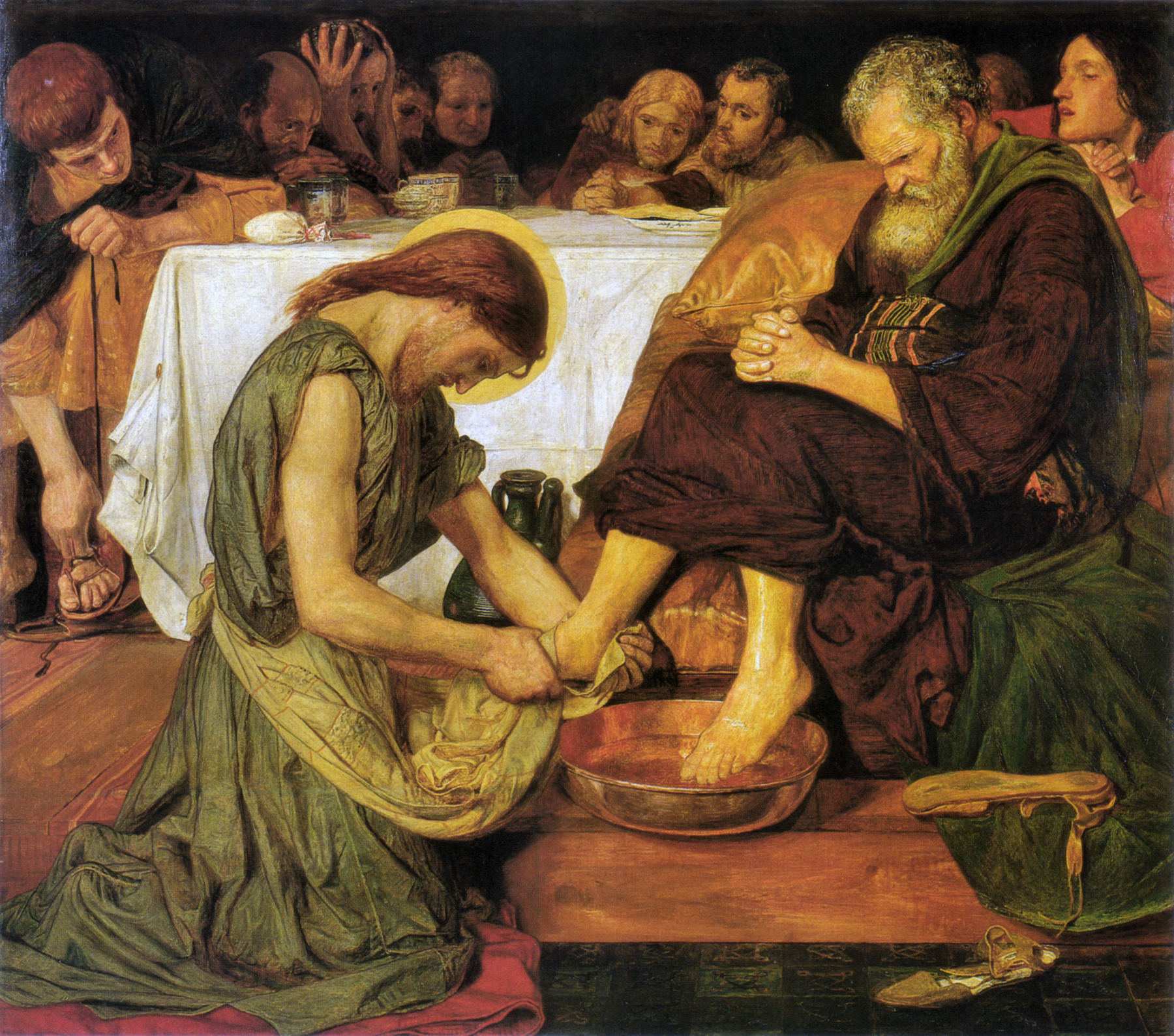
Jesus Washing Peter's Feet

 “I have prayed for you [Simon] that your own faith may not fail; 

and you, when once you have turned back, strengthen your brothers.” (Lk 22:32). 


"Modern" artists of the 19th century sought to re-establish the "natural" and "heartfelt" approach that they believed had dominated painting, sculpture and literature before the more staged and self-conscious style of Renaissance artists like Raphael. Eventually, this movement organized itself into the "Pre-Raphaelite Brotherhood." Born in France in 1821 and educated in Belgium and France, Ford Madox Brown visited Italy as a young man and was strongly influenced, by the historic masterpieces there and by the first stirrings of that new movement in art. This is apparent in Brown's 1856 "Christ Washing St. Peter's Feet" (found today in London’s Tate Gallery).


The figure of Christ dominates the foreground as in almost no other artistic rendition of this dramatic moment at the Last Supper. The hem of his garment even seems to flow past the edge of the canvas. Brown shows us a Jesus who is entirely focused on his self-appointed task. His head is bent at an uncomfortable right angle to the chest, perhaps hinting of his bowed head on the cross; his eyes are fixed not on Peter's face, but on his feet. The sleeves of Christ's tunic are pushed up, revealing his muscular arm all the way to the shoulder. The painting seems to impose an atmosphere of profound silence even on the viewer. Certainly, the apostles are struck dumb at seeing "the might of the Lord's arm" employed in such a pointedly servile manner (see Psalm 98:1). If John is peering over Peter's shoulder in thoughtfulness, the other apostles (again, save one) are looking on in horror. Only Judas seems blasé as he bends down over his own feet to loosen his sandal. Peter, on the receiving end of the Lord's quietly deliberate action, looks decidedly ill at ease, but his sandals, with their straps hanging down limply, tell us that he is on holy ground.


At first, Peter's response had been almost the opposite of the Virgin Mary's. She had said, "be it done to me": he had protested, "You shall never wash my feet!" Mary called herself God's slave-girl. Peter, at this point in his life, cannot bring himself to say anything similar. Peter realizes that "If I, the Lord and Master, have washed your feet, then you must wash each other's feet…" And unless he accepts that, he can "have no share"—no communion—with Jesus. He doesn't yet understand, but soon enough he will. And when his own hour comes, he will write to a new generation of disciples, "Christ suffered for you and left you an example, to have you follow in his footsteps" (1 Pet. 2: 21).


This work is in the public domain in the United States; Tate Britain (The Tate Gallery) claims copyright in the United Kingdom on this digital reproduction.

Christ Heals the Blind Man

The best biblical artist you never heard of, Andrei Nikolaevich Mironov was born in 1975 (the same year I entered the convent!), but only started exhibiting his art in 2007. That makes his 2009 painting, "Christ and the Pauper. Christ Heals the Blind Man" one of his earliest public works. 

According to the writeup on his page in GallerySwarm, “Andrey attempts to illustrate, supplement and portray in tangible form the principles of Christianity.” Mironov has completed literally dozens of biblical scenes, and at times several versions of the same biblical event or story, most of these taken from the Gospels. The simplicity of Mironov's image and its narrow dimensions can give the impression of being on an heroic scale, but the oil painting is roughly half life size (100 X 55 cm, or 3.3 feet tall and 1.8 feet across). 

As attested to in Scripture, Jesus healed any number of beggars who had lost their sight. That this is the man born blind (John 9) seems to be hinted at by the position of Jesus’ right hand, which could be holding the mud paste he had made with his spit to anoint the sightless eyes of the beggar. The man's left hand is still somewhat, perhaps habitually, open to receive alms (and what an alms!), but his face is fully lit, awaiting only for that light to penetrate his eyes.

Meditating on the Woman at the Well

 “This well is deep. Where do you intend to get this flowing water?” (John 4:11).

In his painting, Insight, German priest-artist Sieger Köder (1925-2015) places us at the bottom of a deep, dank well, looking up toward the distant light. A small, roughly painted image of a woman peers down toward us. In between, dark, uneven stones etched with moss form a tower. Stagnant air seems to exude from the scene.


Köder’s art, with bold colors, clearly outlined shapes, and frequent allusions to Old Testament themes and images, recalls that of Chagall. As an artist, Köder had much in his own life to draw from, having been a prisoner of war, but also a silversmith, painter and high school art teacher before beginning theological studies at age 41. After ordination, he served as a parish priest and continued to paint and create stained glass, altarpieces, and murals.  Köder’s figures express powerful emotions, and his scenes often contain hidden reflected images. We find a prime example of this in the deep waters of Samaria.


There is something strange about the water in this deep well. The surface is rippled, as if it were “living water” in the usual first-century meaning of the term: not stagnant or still (like well water), but fresh flowing water from a stream or fountain. And in that flowing water we find two faces, not one, reflected. The woman’s features are clearer here in the rippled water than in the open air. And beside her is Another. 


When the whole image is turned upside down, she seems to be standing with Jesus. Together they reread her past in the light of God: no longer a succession of sorrows, it is radiant with hope. Having met Jesus, she was transformed and set free, able to run into the town and gather a crowd who would come and see for themselves that “this is truly the Savior of the world” (Jn 4:42).


Read the whole story of Jesus and the woman at the well: John 4: 1-42


Friday, October 03, 2025

Meanwhile, in Rome...

Sunset on the Mediterranean; view from Ariccia.
Greetings from the Eternal City! I arrived here on September 2 to serve as a translator for my congregation's General Chapter, an international meeting that establishes the priorities for the. next 6 years and then elects the Superior General and her council to take them on. So far the priorities have been established, and the new Superior General has been elected. (She is Korean, our first Asian Superior General. It is also the first time in my religious life that the Superior General is younger than I--and by 9 years!) Today and tomorrow the sisters will be electing the six councilors. During the voting, all non-voting personnel vacated the premises--a retreat house in Ariccia, on the edge of an old (hopefully extinct) volcano, and overlooking Lake Albano, the same crater lake that the Pope's summer residence of Castel Gandolf looks down on. But from our vantage point, when the day is clear enough, we can look to the northwest and also see the Mediterranean, 20 miles away. 

So I am in Rome while the voting takes place in Ariccia. That has given me two days to wander around Rome, revisiting favorite spots and discovering new ones. On Wednesday I was not alone. A Pauline Cooperator named Patt was in town with a women's group and had the morning free, so we spent it together, picking up religious articles for the Pope to bless and enjoying a really good lunch. Yesterday I was on my own. I let providence plan my itinerary; I only had one fixed goal for the day, and that was for a guided tour of the catacombs under the Basilica of St. Agnes on the via Nomentana. I took the first bus that came my way and followed that route until it met with the tram into the heart of the historic district. From there, I walked to the Jesuit's mother church and lit candles at the tomb of St. Ignatius. Then I meandered to what I had hoped was a significant museum, but it was closed for repairs. So I meandered some more and found a little Church dedicated to the Blessed Mother. A saint (founder of a religious order) was buried there, but I forgot who he was. There was a lovely painting of the birth of St. John the Baptist, and a Conversion of St. Paul that I had never seen. I tried to take pictures of them; sadly, my phone's camera leaves much to be desired. 

Tourists in line for the Bocca di Verità
My next stop was the slightly decrepit (and under restoration) church of St. Nicholas. This was the site of not one, not two, but three Roman temples, the remains of which are still visible. The columns in the nave were all different, scavenged from various Roman sites. Because of the restoration work, I was unable to see what the altar and sanctuary were like. I will have to come back! A block on, I found the Vestal Temple (as in Vestal Virgins), and then the "Bocca di Verità" in front of St. Maria in Cosmodin. The line for the Bocca di Verità (the Roman version of a whistleblower's drop) went halfway down the block, but there was no line at all to enter the church, so I happily went in. Eastern chant was playing on the sound system, a way to keep visitors in a reflective frame of mind. This Melkite Catholic Church (Byzantine-ish) started off 1700 years ago or so as a soup kitchen and social services ministry, a diaconia.  It only became a church later. I was able to go down below the altar where there were many wall niches which once held relics. Now the only relic you can see is upstairs: the skull and bones of St. Valentine (yes, that St. Valentine). 

From there, I set the GPS for St. Mary Major, since it was about noon and most churches close at that hour. My route took me to the Forum, but to cut across I would have to go through security (and pay an entrance fee?), so I took another path and ended up climbing the Capitoline hill, past the Ara Coeli, and then down the "Via dei Fori Imperiale" toward the Colosseum, and then up Via Cavour to the Basilica. After waiting in line to go through the Holy Door, I found myself in another (slow!) line passing by Pope Francis' grave. It took a while before I could really wander freely in the Basilica! But I did, finding the Adoration chapel and praying a Rosary. 

After a bite to eat (I had already gone through my snacks!), it was time to go to St. Agnes. According to the website, the Church would open at 3. I got there way too early, but that gave me a chance to explore the area: all of the gates were open.  

To my surprise, I found signs for a "mausoleum." Turns out that Constantine's daughter built her own mausoleum right on the grounds of the cemetery where St. Agnes had been buried. It is still standing today, a little round church (though the enormous porphyry sarcophagus is now in the Vatican Museum). The original mosaics (fourth century!) are still on the ceiling of the aisle that encircles the sanctuary. Too bad I didn't have a 50c Euro coin to turn the lights on, but then, the Romans didn't have electric lights either, so I was seeing things in the filtered sunlight just as they did. 

After exploring the little chapel, I ventured toward the "new" Basilica (seventh century; the Constantinian basilica was so big it collapsed under its own weight; only the apse wall remains).
There was a pretty grand marble staircase going down about 20 feet, so I followed it down. It took me into the Basilica itself, where everything was draped in plastic (So much for seeing the famous mosaics there!!!). An exit led me to the visitor's office, and just in time, too! A German tourist had been inquiring about a tour and was told that they were not able to give tours to individuals. Then I showed up! Voila! The two of us got a guided tour of the fascinating catacombs under the Basilica. There are still many intact burials there, with the niche still secured behind clay tablets. So many interesting details! No photos were allowed, so you will have to go see them yourself. There were even a few niches framed in glass, and the skeletons of those who had been laid to rest 1700 years ago were visible. Many of the intact funeral monuments were for toddlers. A Roman child was lucky to live past two. The tour ended at the 16th-century silver urn with the remains of St. Agnes and St. Emerentiana, her foster sister, killed a few days after Agnes (while praying at her tomb!). 

Meanwhile at the Vatican, the voting members of the General Chapter had a private audience with Pope Leo. You can read all about it. I just want to draw your attention to the book and the music that he is receiving from my provincial. The music is a song that I wrote during the pandemic; I wrote the lyrics, that is. A Chicago friend wrote the music, which I was able to record over the summer (with the help of a New Orleans friend). Now you can listen to it, too (and maybe share it on your social media or use it at your parish). Here is the link for the audio and for the printable music: https://pauline.org/pbm-resources/eyes-aflame/ Also, if you know anyone who reads Czech, my book is now available in that language!!!

Today I had hoped to visit St. Cecilia's in the Trastevere district, but my plans were disrupted by a strike and a protest. Maybe tomorrow. I will catch up on odds and ends here at the Generalate, preparing my luggage for the return to Boston next week (after the Jubilee of Consecrated Life and Mass with Pope Leo).  Your prayers are much appreciated for our new General Government and for our sisters all over the world, especially in places that are plagued with persecution and violence.

Wednesday, June 11, 2025

The subtle lure of "ableism"

The vote in favor of New York state's assisted suicide bill had me digging up a short talk I offered at an archdiocesan gathering of disability advocates here in New Orleans when I first arrived. With some modifications (owing to the format, not the content), I share it here with you:

I imagine that part of what you will be doing this morning is discerning helpful ways to use media in the service of faith and prayer. And some of you are able to do that because media technology are being used in a helpful way. My community, the Daughters of St. Paul, isn’t just about selling books as a way of supporting ourselves; we are committed to evangelizing with the media, and we have a publishing house, Pauline Books and Media. But there's more to it even than that:


As Daughters of St. Paul, part of our mission is to make reparation for media that take people away from God, that twist human activity, but also human minds and hearts, and harm individuals and society. 


We have our work cut out for us.


In the second Letter to the Corinthians we see how the people of Corinth scorned Paul. He just didn’t measure up to the people they admired: people of eloquence and athletic stamina. Today we have “Instagram perfection” in which any outward disfigurement becomes a disability. 


Facing life with a serious disability or at the side of a person with a disability (especially when that is profound) has become almost unthinkable for many people today in part because of how the media have conditioned us: not only our way of seeing people, but the way limitations are typically presented, dealt with, ignored, or abhorred in media. When people with disabilities are represented, they can often be caricatures. 


So this morning, I invite you to join me in a prayer of  reparation for media:

  • Media that targets vulnerable persons or undermines their dignity in any way;
  • Media portrayals that focus on the human person in isolation, the person who defines himself or herself without relationships of love, trust, acceptance, forgiveness;
  • Media that promote false ideals of physical flawlessness with Instagram perfection and Photoshopped bodies;
  • Media especially that creates addictive experiences for children and young people, some of whom hate their own beautiful, strong, healthy bodies because of what they have seen and perhaps done in imitation of media models.

And let’s pray in intercession for people, especially media influencers, who cannot recognize the dignity of persons with disabilities, and whose media creations spread that narrow vision of the human person like a contagion.


For further reflection:


"Really and radically every person must be understood as the event of a supernatural self-communication of God" (FCF 127; Karl Rahner).


“God is there in these moments and can give us in a single instant exactly what we need. Then the rest of the day can take its course, under the same effort and strain, perhaps, but in peace. And when night comes, and you look back over the day and see how fragmentary everything has been, and how much you planned that has gone undone, and all the reasons you have to be embarrassed and ashamed: just take everything exactly as it is, put it in God’s hands and leave it with Him. Then you will be able to rest in Him—really rest—and start the next day as a new life" (St. Teresa Benedicta of the Cross).


The French mystic Gabrielle Bossis, in prayer, understood Jesus telling her, “Give Me your suffering. No one can give it to Me in heaven. Give it to Me.”

Saturday, May 31, 2025

Sacred Heart resources

For those who attend my presentations on Devotion to the Sacred Heart and would like to delve a bit more into the resources I used, here is a list of the most important documents and books. (The book links are "affiliate links" which earn me a bit of credit for... more books!)

Books

I am assuming you already have my book, but just in case you don't, I will list it first!

Come to Jesus: Living the Nine First Fridays, by Sr. Anne Flanagan, FSP; there's also a Group Guide for my book, so you can make the Nine First Fridays with your neighbors, co-workers, or fellow parishioners. (It even has an original song for Eucharistic Adoration!)


Heart of the Redeemer, by Timothy T. O’Donnell (a classic)


A Heart on Fire: Rediscovering Devotion to the Sacred Heart of Jesus, by James Kubicki, SJ


A Cardiologist Examines Jesus: The Stunning Science behind Eucharistic Miracles, by Dr. Franco Serafini


Heart Speaks to HeartThis pastoral letter by the then-Archbishop of Toronto (Cardinal Colins) is a downloadable e-book (pdf). Written in the midst of pandemic restrictions, it is an excellent summary of all the most significant things about the devotion to the Sacred Heart of Jesus.


Papal Teachings (in historical order)

Leo XIII

Annum Sacrum (encyclical on the consecration of the world to the Sacred Heart of Jesus)

Pius XI

Miserentissimus Redemptor (encyclical on the theme of reparation to the Sacred Heart of Jesus)

Caritas Christi Compulsi (encyclical): This is primarily a social encyclical, released at the height of the Great Depression, but the Holy Father emphasizes devotion to the Sacred Heart as a much-needed remedy to restoring the social order. It is surprisingly relevant to the issues we are facing right now.

Pius XII

Haurietis Aquas (encyclical): This is the first major encyclical on the Sacred Heart of Jesus. Issued for the 100th anniversary of the establishment of the Feast of the Sacred Heart on the Universal Calendar, it has been a theological reference point ever since.

Paul VI

Investigabiles Divitiae Christi: 1965 Apostolic Letter on the 200th anniversary of the first approval of the Feast of the Sacred Heart (limited to Poland, but still); This lovely little document is only available in Italian, Latin, and Croatian, so I am linking to a translation service for the English, which will no doubt be stilted. I hope the link works! https://www-vatican-va.translate.goog/content/paul-vi/it/apost_letters/documents/hf_p-vi_apl_19650206_investigabiles-divitias.html?_x_tr_sl=it&_x_tr_tl=en&_x_tr_hl=en&_x_tr_pto=wapp

If the translation link does not work, here is the Italian version for you to cut and paste in any translation service you rely on: https://www.vatican.va/content/paul-vi/it/apost_letters/documents/hf_p-vi_apl_19650206_investigabiles-divitias.html

John Paul II

General Audience (catechesis), June 20, 1979

Angelus message, June 27, 1982: This was the first in a series of brief reflections (I am trying to find the other ones!) on the Litany of the Sacred Heart. Unfortunately, it is not available in English, so I am linking to a translation service here: https://www-vatican-va.translate.goog/content/john-paul-ii/it/angelus/1982/documents/hf_jp-ii_ang_19820627.html?_x_tr_sl=it&_x_tr_tl=en&_x_tr_hl=en&_x_tr_pto=wapp And if this did not come out right, you can paste the original Italian into the translator of your choice: https://www.vatican.va/content/john-paul-ii/it/angelus/1982/documents/hf_jp-ii_ang_19820627.html

Homily in Vancouver, September 18, 1984: Given at a Mass in honor of the Heart of Christ

Letter to the Jesuit Superior General, October 5, 1986: This letter was written from Paray-le-Monial and commemorates the Jesuit commitment to spreading devotion to the Sacred Heart of Jesus. It is only available in French, Spanish, and Italian, so, as I did above for Paul VI's document, I am linking to a translation service for the English. (In case it fails, here is the French page, so you can copy and paste the letter into a translator: https://www.vatican.va/content/john-paul-ii/fr/letters/1986/documents/hf_jp-ii_let_19861005_preposito-francia.html?_x_tr_sl=it&_x_tr_tl=en&_x_tr_hl=en&_x_tr_pto=wapp.)

Letter on the 100th Anniversary of the Consecration of the Human Race to the Sacred Heart, June 11, 1999

Angelus message, June 23, 2002

Angelus message, June 20, 2004

Benedict XVI

Letter to the Superior General of the Jesuits, May 15, 2006: Commemorating the 50th anniversary of Pope Pius XII's encyclical Haurietis Aquas (I told you it was important!)

Francis

Dilexit Nos: On the Human and Divine Love of the Heart of Jesus Christ (encyclical): the first Sacred Heart encyclical in 68 years, and a wonderful compendium of theology and devotion. If you only plan to read one Church document on the Sacred Heart, it should be this one. You can also get this in a very handy paperback from my community. This will allow you to underline, highlight, and bookmark to your heart's content: https://paulinestore.com/dilexit-nos-on-the-human-divine-love-of-heart-of-jesus-christ.html


Other online resources

A thorough study of Pope John Paul's teachings on the Sacred Heart, by Msgr. Arthur Calkins.

A 23-part study of devotion to Sacred Heart of Jesus in its relation to the Divine Mercy devotion, by Dr. Robert Stackpole begins with this first installment: The Plan of the Heart of Jesus to Drive Back the World's Darkness; links to the other installments (although not in order!) can be found on the webpage: https://www.thedivinemercy.org/search/content/More%20Brilliant%20than%20the%20Sun 


Monday, May 12, 2025

Pope Leo XIV: A Pope "with the smell of the sheep"

Screenshot of the official photo
We started the Easter Season on the last day of Pope Francis' earthly life, and now at the beginning of the Fourth Week of Easter we are at the start of a new Pontificate. A lot can happen in three weeks!

Most of us are just getting to know the new Holy Father. Unfortunately, some Catholics are already establishing litmus tests for him. This is not just unhelpful, it is spiritually dangerous. It means judging a Pope and his ministry according to our own cherished values, and not within the faith of the Church. (It may even be a signal that, for all practical purposes, our own values or personal convictions have replaced the faith of the Church.)

Anyway, we owe it to the Successor of St. Peter to give him the chance to shepherd the Church of God, and to allow ourselves to be shepherded. And for that, it helps to get to know where this new shepherd is coming from--in his own words, and not from headlines or social media. Because the disinformation (and the partially-edited information) is already swirling out there. If you see a post that intrigues you, go ahead and read it--but then go behind it, to the original source. Do your homework, in other words.

For example, you may have seen allegations that in the past, Father (or Bishop) Prevost dropped the ball in cases of sexual abuse by priests. That was investigated very promptly by a reliable news service. (Crux of the News is a for-profit news service that specializes in Catholic Church news, and reflects very high ethical and journalistic standards.) You can read their full report here: https://cruxnow.com/vatican/2025/05/serious-questions-of-credibility-surround-coverup-allegations-against-new-pope

On another topic dear to my heart, I have seen a few posts about the then-Father Prevost's short intervention at the 2012 Synod of Bishops. So I went to the Vatican website (vatican.va) and looked for it! Yes, it is there--and now it is here, for your convenience. Lo and behold, he is talking about our media-dominated culture! I have helpfully highlighted a few lines I think especially pertinent. (Those highlights are me, pushing my agenda!)

- Rev. F. Robert Francis PREVOST, O.S.A., Prior General of the Order of St. Augustine (Augustinians)

At least in the contemporary western world, if not throughout the entire world, the human imagination concerning both religious faith and ethics is largely shaped by mass media, especially by television and cinema. Western mass media is extraordinarily effective in fostering within the general public enormous sympathy for beliefs and practices that are at odds with the Gospel.
However, overt opposition to Christianity by mass media is only part of the problem. The sympathy for anti-Christian lifestyle choices that mass media fosters is so brilliantly and artfully engrained in the viewing public, that when people hear the Christian message it often inevitably seems ideological and emotionally cruel by contrast to the ostensible humaneness of the anti-Christian perspective.
If the "New Evangelization" is going to counter these mass media-produced distortions of religious and ethical reality successfully, pastors, preachers, teachers and catechists are going to have to become far more informed about the challenge of evangelizing in a world dominated by mass media
The Fathers of the Church, including Saint Augustine, can provide eminent guidance for the Church in this aspect of the New Evangelization, precisely because they were masters of the art of rhetoric. Their evangelizing was successful in great part because they understood the foundations of social communication appropriate to the world in which they lived.
In order to combat successfully the dominance of the mass media over popular religious and moral imaginations, it is not sufficient for the Church to own its own television media or to sponsor religious films. The proper mission of the Church is to introduce people to the nature of mystery as an antidote to spectacle. Religious life also plays an important role in evangelization, pointing others to this mystery, through living faithfully the evangelical counsels. 

For a week or two, Pope Leo will be a media darling. Don't let that make you undiscerning when it comes to stories or articles that relate in some way to his ministry. Even Catholic media can be influenced by criteria that are not in line with the Church's wisdom. When in doubt, throw them out and just stand with Peter!!!


Saturday, April 26, 2025

Appreciating Pope Francis (Part 3)


In my previous two posts, I wrote about two core influences on the way Pope Francis, starting early in his ministry as a Jesuit leader, saw his role (and that of the Church in the world). They led him to appreciate the input of the often-overlooked. In other words, to listen to the "faithful people."

As rector of the Colegio Maximo in Buenos Aires, in 1976 Jorge Mario Bergoglio revised the academic program to “root students in Jesuit and Argentine traditions, rather than foreign models” (Ivereigh, 140). “Bergoglio wanted the Jesuits to value popular religious traditions alongside high culture” (The Mind of Pope Francis, p 44-45). He wanted nearness, listening to the life of the people and not, as the First Letter of John says, “not just talking about it.” Closeness to the people meant cultivating a genuine appreciation of the popular expressions of faith. As Francis says in Evangelii Gaudium, popular devotions are the inculturation of the Gospel on the part of a believing people; they are a sign of the Gospel’s having taken root and beginning to bear fruit; they are a new “incarnation” of the Word among us. (How fitting it is, then, that his last encyclical would be focused on a popular devotion, the devotion to the Sacred Heart of Jesus!) 


In other words, when he started his ministry, there was no “polar opposition” between the European philosophical and theological mindset and that of the local churches. There was only a European approach. It did not even have to attempt any form of inculturation, much less incorporate Argentine cultural and philosophical works into the program of studies. Nothing but the European achievements had a place in the Jesuit seminary. And in the 70’s, with some of the Jesuits embracing a Marxist approach to social problems, it may have seemed that allowing anything but the most stringently vetted, historically proven texts into the formation program was playing with fire. 


But the 1968 Medellín Conference (2nd Episcopal Conference of Latin America) had affirmed “‘popular religious tradition’…teología del pueblo—immersion to the degree possible in the lives of the neighborhood and the families there, a ‘unity of theory and praxis’ in line with the ‘preferential option for the poor.” A later document from the Argentine bishops “saw the people as active agents of their own history” and said “the activity of the Church should primarily derive from the people” but not “people” understood in Marxist terms—it was “ordinary people,” not a class.


Borghesi writes: “Bergoglio…sought to restore a place of dignity to the country’s own historical and cultural background, which had become somewhat lost in…modernizing, Americanizing, and Marxist currents” as well as a “return to the sources” for the Jesuits, with special attention to the movement of the Spirit of God.


The “San Miguel” document from the Argentine bishops does not express “pueblo” in “sociological or Marxist terms”; “the declaration saw the people as active agents of their own history…it asserted that ‘the activity of the Church should not only primarily derive from the people’… the option for the poor understood as radical identification with ordinary people as subjects of their own history, rather than as a ‘class’ engaged in social structure with other classes” : not Marxist; a “liberation theology without Marxism.” (We can ask ourselves if “culture wars” from the right fall more in line with this “class struggle” than conservatives might like to admit.)


Gustavo Gutiérrez (OP; died Oct 2024), who introduced the term “liberation theology” revised his own seminal work to take on this “theology of the people.”: “being poor is a way of living, thinking, loving, praying, believing, and hoping”; “the economic dimension [“lack of food and housing, the inability to attend properly to health and educational needs, the exploitation of workers”] itself will take on a new character once we see things from the cultural view.” 


“Gutiérrez now recognized the importance of popular belief, prayer and dialogue with Latin American culture in its concrete expressions, and he turned away from Marxism’s primacy of praxis and revolutionary (counter) violence. .. popular devotion, freed from ‘devotionalism’ and the prejudices of an Enlightenment point of view [one that the earlier Gutiérrez had fully embraced, considering “the religious dimension of the culture of the people…a sort of premodern residue” (The Mind of Pope Francis, 51, 50)] is a legitimage locus theologicus, proof of a distinctly Latin-American enculturation of faith”


Evangelii Gaudium 126 (within 122-126): underlying popular piety, as a fruit of the inculturated Gospel, is an active evangelizing power which we must not underestimate: to do so would be to fail to recognize the work of the Holy Spirit. … they are a locus theologicus which demands our attention.”


Bergoglio to the Jesuits in 1974: “By faithful people I means simply the people who make up the faithful, the ones with whom we have so much contact in our priestly ministry and religious witness. It is clear that now… ‘people’ has become an ambiguous term because of the ideological assumptions with which this reality is discussed and perceived. …I was very struck [in my studies] by a formula of the tradition [from Denziger]: the faithful people are infallible ‘in credendo,’ in belief. From this I have drawn my own personal formula… When you want to know what Mother Church believes, turn to the Magisterium, since it has the role of teaching in an infallible way; but when you want to know how the church believes, turn to the faithful people. The Magisterium will teach you who Mary is, but our faithful people will tach you how to love Mary. Our people have a soul, and when we speak of a people’s soul, we also speak of a hermeneutic, a way of seeing reality, a knowledge….”


“The concept of the believing people refers for him to the historical ways that faith animates life, reality, culture It points to the how of the incarnation. … the historically lived terrain that nourishes the faith of the Church” (The Mind of Pope Francis).


Text Box: Starting point of listening.Evangelii Gaudium 125: “it is only when we start from the affective co-naturality that loves supplies that we can appreciate the theological life present in the piety of the Christian people, especially in that of the poor." 


Text Box: Both/and
Polar opposites
Puebla Document (Latin American bishops): The Catholic wisdom of the common people is capable of fashioning a vital synthesis. It creatively combines the divine and the human, Christ and Mary spirit and body, communion and institution, person and community, faith and homeland, intelligence and emotion. This wisdom is a Christian humanism that radically affirms the dignity of every person as a child of God, establishes a basic fraternity, teaches people who to encounter nature and understand work, and provides reasons for joy and humor even in the midst of a very hard life.”


Text Box: He clarifies: not a mere “synthesis” that combines things or puts them side by side, but a “creative union” that is something new and yet retains the key features of both perspectives.The then-Archbishop of Buenos Aires comments: “The tensions mentioned by Puebla…are universal. The vital synthesis, the creative union of these tensions, inexpressible in words because it would require all of them…translates into ‘proper names” like Guadalupe and Luján, into pilgrim faith, into gestures of blessing and solidarity, into offerings and into songs and dances…. This heart with which and thanks to which our people love and believe is a theological place with which the preacher must be vitally connected.”


In 1974 (most likely to SJs), the future Pope taught: "This faithful people does not separate its Christian faith from its historical expressions, nor mix them up in a revolutionary messianism. This people believes in resurrection and life; it baptizes it children and buries its dead. Text Box: “Unity is superior to conflict”: the first of the “fundamental principles”Our people pray…for health, work, bread, family harmony; for the nation, they ask for peace. … a people that asks for peace knows perfectly well that peach is the fruit of justice.”


Text Box: 2nd principle: The whole is superior to the partsJMB in 1974: “In fruitless clashes with the hierarchy, destructive conflicts between ‘wings’ [left-wing, right-wing], we …. ‘absolutize’ what is secondary…giving, in the end, more importance to the parts than to the whole.” 


Over the course of time, the future Pope articulated the principles that he consistently used in entering into discussions, seeking resolution of serious issues, and even evangelizing. Knowing these four principles can help us interpret the things Pope Francis write (they are all over the place in Evangelii Gaudium) and what he did, that “style of relating” to the “other” that drove some people crazy because it seemed to stand in between two sides, as if relativizing one’s own perspective. Instead, it was not so much relativizing a perspective as attempting to keep two “antinomies” united in tension. He would tell us, I am sure, that this is the only way we can enter into a fruitful conversation. It is his way of establishing open communication, of listening to and for the other.


In these “theoretical principles,” he is articulating a hierarchy of values that bear on dialogue:

Unity is superior to conflict.

The whole is superior to the parts.

Time (process) is superior to space.

Reality is superior to ideas.


All three of the original principles/criteria aim at “unity of action”


Text Box: 1-Unity is superior to conflict
2-The whole is superior to the parts

These are “criteria of synthesis and are intended to foster social and political peace”

“The method for arriving at synthesis… “  Text Box: 3-Time is superior to spaceprocesses rather than “the desire for domination that calls for occupation of spaces.” (I remember a physicist in my theology class who said, “I have learned to be at peace with process.”)


Text Box: 4. Reality is superior to ideas.In 1980, another principle: JMB, 1976: “We are divided because our commitment to people has been replaced by a commitment to systems and ideologies. We have forgotten the meaning of people, concrete people…with all their historical experiences and clear aspirations.”


Text Box: “Unity through reduction is relatively easy but not lasting.”To his fellow Jesuits he said, in 1976: “Unity through reduction is relatively easy but not lasting. More difficult is to forge a unity that does not annul differences or reduce conflict.” 


In 1978, to the Jesuits united for a congregational meeting, he summed up: “Neither one nor the other: neither traditionalists nor utopianists”; rather, “resort to the ‘classic’ … [and not what is merely] ‘traditional,” to the empty traditionalism that is concerned only with maintaining peace…. By ‘classics,’ we refer to those powerful moments of experience and religious and cultural reflection that make history because, in some way, they touch the irreversible events of the journey of a people, of the Church, of a Christian…”

“The ‘classics’ have provided the strength of synthesis in moments of conflict. These are not easy ‘compromises’ or cheap ‘irenicsm.’ these are the syntheses that, without denying the contrary elements that cannot be simply combined in such crises, find resolution at a higher level, through a mysterious journey of understanding and of fidelity to what is perennial in history. For this reason, the ‘classic’ possesses thisdouble virtue of being faithful to history and of inspiring new paths to be undertaken.”


Then, in 1999: “The true, the beautiful, and the good exist. The absolute exists.”


And again, in 2002 [on “information”]: “good, truth, and beauty are inseparable at the moment of communication between us, inseparable in their presence and also in their absence. And when they are absent, good will not be good, truth will not be truth, and beauty will not be beauty.”


“…truth cannot be found by herself. Next to her is goodness and beauty. Or, to put it better, the truth is good and beautiful. ‘A truth that is not entirely good always hides a good that is not true,’ said an Argentine thinker" (Jorge Mario Bergoglio in 2008).

This is as much as I am able to write on the fly, drawing from a talk I prepared for a congregational meeting that took place this past January. I highly recommend the book The Mind of Pope Francis, and consider it essential for a proper understanding of the ministry of Pope Francis, and an important tool for interpreting his documents, talks, and practical choices. 

And now, may the Holy Spirit strengthen us for the next stage of our journey as the Body of Christ!